
Written by: Tanis Zamora | Category: The Foundation

A lot of people hear “Backwards Manifesting” and assume it’s a rival system — something built to replace visualization, affirmations, and the other techniques they already know. Others assume it’s a rejection of those techniques altogether, as if believing in them was the problem all along.
Neither is true. Backwards Manifesting was built to work alongside Traditional Manifesting, not against it.
This article breaks down what each philosophy actually teaches, where they differ, what they share, and how Backwards Manifesting and Traditional Manifesting fit together in practice.
Traditional Manifesting is the set of practices most people picture when they hear the word “manifesting.” It has been taught for years across books, courses, and social media, and its core techniques stay fairly consistent no matter who is teaching them.
Every one of these techniques rests on the same assumption: belief can be adopted directly, the way you’d put on a jacket. Practice the technique enough, and the belief is supposed to follow.
Backwards Manifesting starts somewhere different. Instead of adding a new technique to the list above, it works on the person practicing them — you can read how Backwards Manifesting works step by step for the full process.
A habit, a limiting belief, an old wound, a fear — Backwards Manifesting groups these together as barriers, and it treats them as the real reason visualization or affirmations can feel hollow instead of true. You can say “I am financially free” every morning, but if your spending habits contradict the words, the affirmation feels like pretending.
Readiness is what grows as those barriers shrink. Backwards Manifesting builds it through small wins and real evidence — small, honest actions that prove change is happening rather than hoping it will.
Backwards Manifesting does not ask you to abandon Traditional Manifesting — it prepares you to practice it honestly.

Both philosophies point toward the same outcome. Where they split is in what they focus on, what they assume about belief, and how they define progress.
Traditional Manifesting focuses on the technique itself — doing the visualization, writing the affirmation, practicing gratitude consistently. Backwards Manifesting focuses on what stands between you and doing that honestly. It asks a different question: not “am I practicing correctly?” but “what’s making this feel forced?”
Traditional Manifesting assumes belief can be built by declaring it. Say it enough times, and eventually you’ll believe it. Backwards Manifesting assumes the opposite — that belief has to be earned through evidence before it becomes genuine.
This lines up with what psychologists have found about confidence more broadly. According to the American Psychological Association, mastery experiences — succeeding at something and letting that success shape what you believe about yourself — are the strongest known driver of self-belief, stronger than repeating a statement to yourself. Backwards Manifesting applies that same logic to manifesting: proof changes belief faster than repetition does.
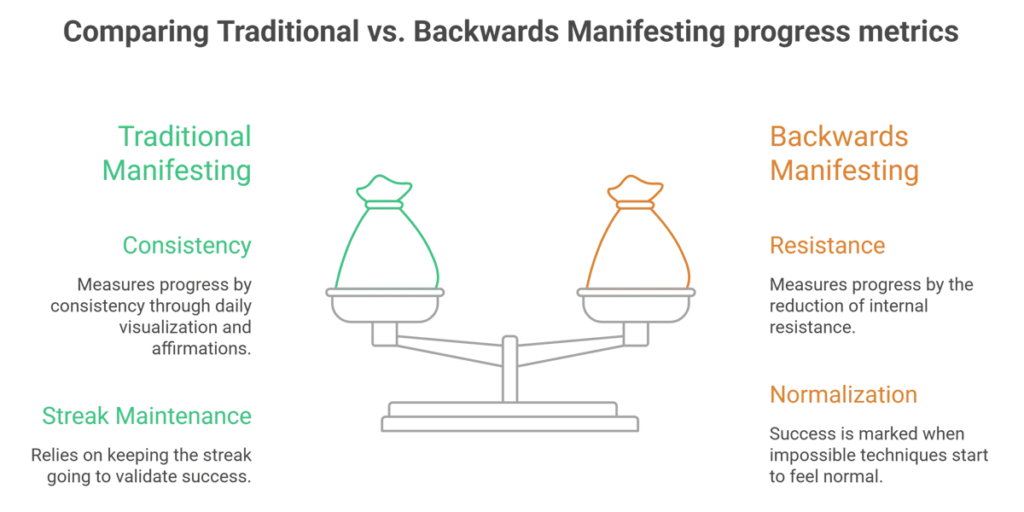
Traditional Manifesting measures progress by consistency — did you visualize today, did you write your affirmations, are you keeping the streak going. Backwards Manifesting measures progress by resistance. If a technique that once felt impossible starts to feel almost normal, that’s the marker of movement, even without a streak to point to.
The differences above are real, but they shouldn’t overshadow how much the two philosophies have in common.
Both are trying to help you build a better life. Neither one treats the other as broken or ineffective — they’re aimed at the same destination, just starting from different places.
Backwards Manifesting doesn’t hand you a new set of tools. Visualization, affirmations, gratitude, and acting as if are the exact same techniques used in Traditional Manifesting. Nothing here is invented or swapped out.
Backwards Manifesting is not opposed to Traditional Manifesting — its purpose is to help bridge that gap until Traditional Manifesting becomes natural, believable, and authentic.

These aren’t two separate tracks you choose between. They run as one continuous process, and Backwards Manifesting doesn’t replace Traditional Manifesting at any point in that process — it runs underneath it.
You keep visualizing. You keep writing affirmations and practicing gratitude. None of that pauses while barriers are being removed — in fact, continuing to practice is part of how the barriers get found in the first place.
This is where the Mirror Principle comes in. If an affirmation still feels forced or dishonest when you say it, that discomfort is information — it’s pointing at a barrier that hasn’t been dealt with yet. If the same affirmation starts to feel natural, that’s evidence the barrier is losing its grip. The technique itself becomes the measurement. You don’t need anyone else to tell you whether you’re ready; the mirror tells you.
Backwards Manifesting was never meant to replace what you already know how to do. It’s meant to make it honest. Traditional Manifesting keeps pointing you toward the life you want, while Backwards Manifesting does the quieter work of preparing you to actually believe in it.
Run them side by side long enough, and the techniques that once felt like performance start to feel like description.
No. Backwards Manifesting was built to work alongside Traditional Manifesting, not instead of it. It focuses on removing the barriers that make techniques like visualization or affirmations feel forced, so Traditional Manifesting can be practiced honestly.
Yes, and that’s how the philosophy is meant to be used. Traditional Manifesting techniques continue throughout the process — they’re not paused while barriers are identified and removed.
If Traditional Manifesting already feels honest and natural, you may not need it. If techniques like visualization or affirmations consistently feel forced or hard to believe, that’s usually a sign that barriers are getting in the way — which is exactly what Backwards Manifesting is built to address.
Explore more Backwards Manifesting articles and continue preparing for the life you’re manifesting.
Surround yourself with people who are preparing for the life they’re asking for. Share your progress, learn from others, ask questions, and grow together.
We’re creating the Beyond The Prayer Community—a place to connect, share what you’re learning, ask questions, and encourage one another along the way.
We’re not quite ready to open the doors, but you can be among the first to know when we do.