
Written by: Tanis Zamora | Category: The Foundation

You sit down to visualize the life you want, and somewhere in the middle of it, a quiet voice interrupts: this isn’t true, and you know it. You want it to be true. You keep going anyway. It still feels like performance instead of belief.
That gap between wanting something and believing it isn’t a personal flaw, and it isn’t proof that manifesting doesn’t work for you. It’s a readiness gap. Readiness gaps close. Understanding why the fake feeling shows up in the first place is where that starts.
The fake feeling has a specific source. It happens when you try to hold a belief your mind hasn’t accepted yet. Wanting and believing feel similar from the inside, but they aren’t the same operation.
Wanting is conscious. You can decide to want a better income or a healed relationship in a single moment. Belief works differently. It’s your mind’s honest expectation of what will actually happen, built from experience rather than decision. You can want financial freedom completely while still expecting your bank balance to look the same next month. Both are true at once. That’s exactly where the fake feeling lives.
When you repeat an affirmation that contradicts what you privately expect, your mind doesn’t ignore the mismatch. It registers it. A University of Waterloo study on positive self-statements found people who already doubted themselves felt worse after repeating affirmations they didn’t believe. Instead of accepting the statement, their minds argued back against it. Forced belief doesn’t convince the mind — it reminds the mind of the distance it’s trying to ignore.
The fake feeling isn’t dishonesty, and it isn’t failure. It’s a signal that the groundwork for honest belief hasn’t been laid yet.
Faking something means knowing it’s false and saying it anyway to create an appearance. That’s not what’s happening here. You’re not lying to yourself — you simply don’t have the internal proof needed to believe what you’re trying to believe. That’s a gap in evidence, not an act of deception.
Not ready is a stage, not a verdict. Anyone who has ever built genuine belief in a skill, a relationship, or a recovery passed through a stretch where it didn’t feel real yet. If manifesting still feels forced for you, that puts you in a normal place in the process, and the next step is identifying what’s actually standing in the way.

The fake feeling isn’t random. It has identifiable sources, and naming them is the first concrete move toward closing the readiness gap.
A few sources show up again and again. Past disappointment leaves you expecting more of the same, even when circumstances have changed. Conflicting beliefs mean you’re affirming abundance out loud while privately expecting lack. Lack of prior proof means your mind has no memory of you actually changing, so it has nothing to build confidence on.
Notice what your mind says right after you visualize or affirm something. Picture the raise and immediately think of last year’s rejection — that’s disappointment talking. Say “I am confident” and picture yourself freezing in the next meeting — that’s a conflicting belief showing up in real time. The fake feeling isn’t a wall. It’s a pointer, and it’s usually pointing at something specific.
Once a barrier is named, preparation is the direct response to it — the groundwork that makes belief possible instead of forced.
Preparation isn’t a generic mindset routine. It addresses the specific barrier you identified. Conflicting beliefs call for tracking the moments your private expectations contradict what you’re affirming. Lack of prior proof calls for deliberately creating small moments of proof your mind can’t dismiss.
Preparation lowers resistance. Instead of asking your mind to accept a claim it has no evidence for, you remove the specific objections it keeps raising, one at a time. That’s slower than repeating an affirmation until it sticks, but it’s the difference between belief that holds and belief that collapses the moment life gets hard — the same idea explored in why preparation may be the missing step when manifesting isn’t working.

Prepared ground still isn’t proof. Small wins give your mind something concrete and low-stakes to work with, which preparation alone doesn’t provide.
Trying to believe a large manifestation outright is like expecting someone to trust you completely after one conversation. It’s too much, too fast, and the mind resists it. A small, believable outcome gets accepted instead of argued with. Once one small thing is accepted as real, the next one is easier to accept too.
A small win doesn’t have to look impressive. It has to be honest and specific.
Repeated small wins don’t stay isolated. They accumulate into real evidence — and evidence, not effort or repetition, is what finally makes belief feel true instead of performed.
One small win is a data point. A pattern of them is proof. Keep five promises to yourself in a row, or stay calm through the same trigger three times in a row, and your mind stops treating it as luck. It starts treating it as who you are now.
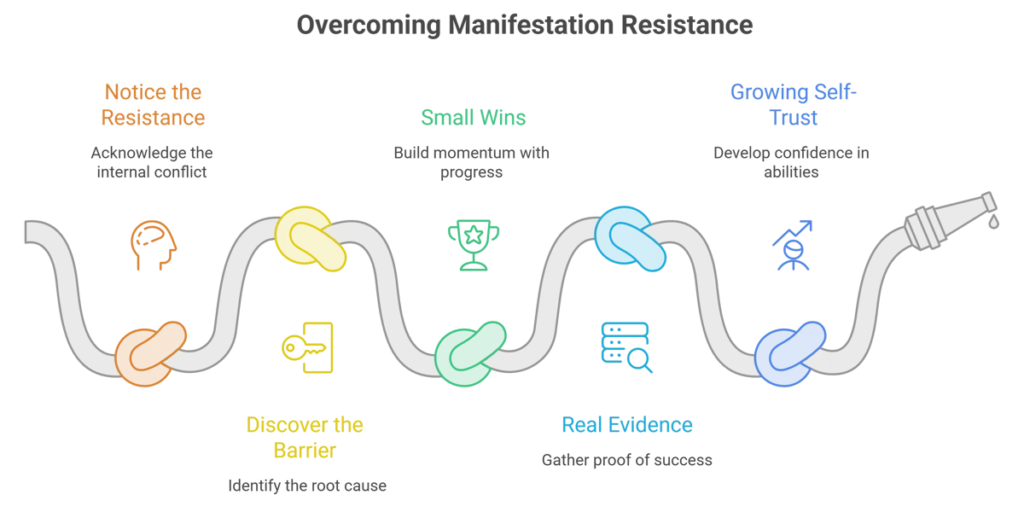
Belief felt forced at the start of this article because it had nothing to stand on. Real evidence changes that. You’re no longer trying to convince yourself of something disconnected from your life — you’re recognizing a pattern you’ve already lived. One version of belief is borrowed. The other is earned.
The fake feeling you started with was never a dead end. It was a signal that you wanted something real badly enough to notice when you were only performing it. That signal pointed to barriers, and barriers can be named, prepared for, and replaced with proof.
What felt forced at the beginning becomes honest by the end — not because you tried harder to believe, but because you finally gave yourself something true to believe in.
Yes. Most people feel this when trying to believe something their mind has no supporting evidence for yet. It’s a readiness gap, not proof that manifesting doesn’t work.
Notice what happens right after you visualize or affirm something. A specific doubt showing up immediately is a barrier pointing at itself, not a failed practice.
It depends on the barrier and how consistently you collect small wins. Some barriers loosen within weeks; others take longer. Evidence accumulates, and belief follows it.
Explore more Backwards Manifesting articles and continue preparing for the life you’re manifesting.
Surround yourself with people who are preparing for the life they’re asking for. Share your progress, learn from others, ask questions, and grow together.
We’re creating the Beyond The Prayer Community—a place to connect, share what you’re learning, ask questions, and encourage one another along the way.
We’re not quite ready to open the doors, but you can be among the first to know when we do.