
Written by: Tanis Zamora | Category: The Foundation

Someone can master every manifesting technique out there — visualization, affirmations, acting as if — and still feel like they’re faking it every single time. That’s not a sign they’re doing something wrong. It’s the specific problem Backwards Manifesting was created to solve.
The philosophy didn’t start as a new technique to add to an already long list. It started as an answer to a narrower question: what happens when you know exactly what to do and still can’t honestly believe it?
Here’s what was missing, and why it had to exist.
Most people who struggle to manifest didn’t skip a step in the process. They know how to visualize, how to write affirmations, how to act as if the life they want has already started. What they don’t have is an honest way to believe any of it while they’re doing it. That’s the real gap, and it’s not one more technique can close.
There’s a difference between performing a manifesting technique and meaning it. A person can sit down every morning, close their eyes, and picture a healthier body, a stronger marriage, a business that finally works — and still feel like they’re watching someone else’s life through a window. The visualization is accurate. The belief behind it isn’t there yet.
That disconnect is what makes so many people quietly give up on techniques they’re doing exactly right. It isn’t the technique failing them. It’s the reason manifesting can start to feel fake even when it’s practiced correctly.
The instinct is to blame effort — try harder, visualize longer, write the affirmation twenty more times. But the gap usually comes from somewhere else entirely: old habits still running in the background, a self-image built over years of disappointment, a body that has learned to expect certain outcomes and reacts before the mind catches up.
A person who has carried debt for a decade can recite abundance affirmations flawlessly and still feel a knot in their stomach every time they say the words. That knot isn’t laziness. It’s a barrier standing exactly where honest belief needs to go.
The problem was never the technique — it was what stood between the person and honest belief.

Backwards Manifesting wasn’t built as another technique to add to the list. It was built because the list was never the problem.
People already had the “what.” They knew to visualize, to affirm, to act as if. What was missing was a workable answer to a harder question: how does someone become the kind of person who can do those things without pretending?
The missing “how” is exactly that piece — not a new practice, but the groundwork that makes the existing ones usable.
Backwards Manifesting exists to prepare the person, not to replace what they’re already doing. That preparation means identifying the specific habits, wounds, and patterns keeping someone from honest belief, then removing them one at a time.
Nothing about Traditional Manifesting changes in this process. What changes is whether the person practicing it can do so without secretly doubting every word.
It was never meant to be another way to practice manifesting. It was meant to be the step that comes before belief.
“Missing link” isn’t a marketing phrase here. It names the specific connection between wanting to believe and actually believing — a connection that has to be built, and this is how it happens.
Most people who feel stuck respond by searching for a better method: a new script, a different meditation, a technique with a number in the name. Backwards Manifesting redirects that energy. Instead of asking “what technique am I missing,” the question becomes “what’s actually stopping me from believing the one I already have?”
A person who keeps affirming financial abundance while avoiding their bank statements isn’t missing a technique. They’re avoiding the barrier the technique was supposed to work around.
Belief doesn’t move because someone decides to have more of it. It moves because a person collects proof. A small win — checking the bank balance instead of avoiding it, staying calm during one specific argument instead of every argument — becomes real evidence that change is actually happening.
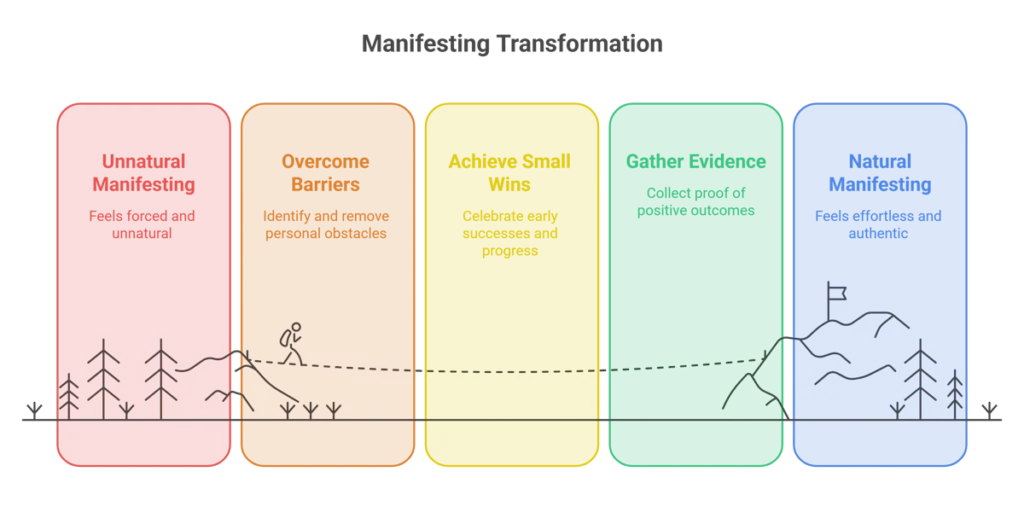
That evidence is what turns “I want to believe this” into “I believe this.” It lines up with what researchers studying self-efficacy have found for decades: people build confidence in their own capability mainly through their own past successes, not through willpower or pep talks.
None of this asks anyone to stop visualizing, stop journaling, or stop practicing gratitude. Backwards Manifesting was built to work underneath Traditional Manifesting. The two were never meant to compete.
A person can keep affirming, scripting, and visualizing exactly as they always have while also working on the barriers standing in the way. The two run at the same time. Preparation isn’t something you finish before going back to your usual practice. It happens alongside it, from the first day. And Backwards Manifesting doesn’t replace Traditional Manifesting — it just makes it easier to practice honestly.
The techniques themselves stay the same. Visualization is still visualization. Gratitude is still gratitude. What changes is how honest they feel to practice. A person who once dreaded their morning affirmations because the words felt like lies may notice, months later, that the same sentences no longer catch in their throat. Nothing about the words changed. The person saying them did.
Backwards Manifesting exists for one specific reason: to close the honesty gap between wanting to believe and actually believing.
That gap isn’t solved by a better technique, more effort, or more willpower — it’s solved by identifying what’s really in the way and removing it, one small win at a time.
Nothing about Traditional Manifesting has to be abandoned in the process. It just becomes something a person can finally practice without pretending.
It names the connection between wanting to believe something and actually believing it — the step that closes the gap between the two.
No. It works alongside visualization, affirmations, and other techniques by removing the barriers that keep them from feeling honest.
People could perform manifesting techniques correctly and still feel like they were pretending. Backwards Manifesting was created to close that specific honesty gap.
Explore more Backwards Manifesting articles and continue preparing for the life you’re manifesting.
Surround yourself with people who are preparing for the life they’re asking for. Share your progress, learn from others, ask questions, and grow together.
We’re creating the Beyond The Prayer Community—a place to connect, share what you’re learning, ask questions, and encourage one another along the way.
We’re not quite ready to open the doors, but you can be among the first to know when we do.